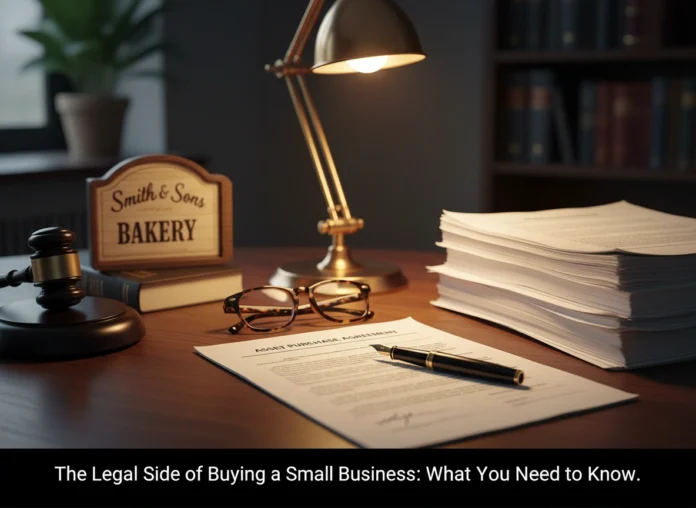
The Legal Side of Buying a Small Business: What You Need to Know

Buying an existing business is often described as a shortcut to entrepreneurship. You skip the grueling startup phase, walk into an operation with cash flow, and inherit a customer base. But beneath the surface of revenue charts and inventory lists lies a complex web of legal obligations.

If you don’t navigate these legal waters carefully, your dream acquisition can quickly turn into a liability nightmare. This guide breaks down the essential legal considerations you must address before signing on the dotted line.

Why Legal Due Diligence Matters

When you buy a business, you aren’t just buying its assets; you are potentially buying its past mistakes. Legal due diligence is the investigative phase where you and your attorney peel back the layers of the company to see what you are really getting into.

This isn’t just about verifying that the business exists. It is about risk assessment. You need to know if the company is being sued, if it actually owns the equipment it claims to, and if its contracts are transferable to you.

What to Look For

During this phase, your legal team should examine:

  • Organizational Documents: Articles of incorporation, bylaws, and minutes from board meetings.
  • Litigation History: Past, pending, or threatened lawsuits.
  • Employee Issues: History of labor disputes, harassment claims, or worker’s compensation issues.
  • Tax Compliance: Proof that all federal, state, and local taxes have been paid.

Skipping this step is the single biggest mistake a buyer can make. If you buy a company that owes $50,000 in back taxes, the IRS may come knocking on your door, not the previous owner’s.

Structuring the Deal: Asset vs. Stock Purchase

One of the first legal decisions you will make is how to structure the purchase. This usually comes down to two choices: an asset purchase or a stock purchase. The legal implications of each are vastly different.

Asset Purchase

In an asset purchase, you buy the individual components of the business—the equipment, the customer list, the inventory, and the goodwill. You generally do not assume the business’s liabilities unless you specifically agree to them.

  • Pro: You start fresh without the company’s past legal baggage.
  • Con: You may have to re-negotiate contracts with vendors and employees, as they don’t automatically transfer.

Stock Purchase

In a stock purchase, you buy the owner’s shares of the corporation. You step into the seller’s shoes and take ownership of the entire legal entity.

  • Pro: It is often simpler. Contracts, permits, and licenses usually remain in place because the entity hasn’t changed—only the owner has.
  • Con: You inherit everything, including “skeletons in the closet” like hidden debts or future lawsuits stemming from past actions.

Most buyers prefer asset purchases to minimize risk, while sellers often prefer stock sales for tax reasons. Your attorney will help you negotiate the best structure for your situation.

The Critical Role of Contracts

A business is essentially a collection of contracts. It has agreements with suppliers, landlords, customers, and employees. As a buyer, you need to know if these contracts are valid and if they will survive the ownership change.

Lease Agreements

For many small businesses, the location is the most valuable asset. You must review the lease agreement carefully.

  • Transferability: Does the lease allow the seller to assign it to a new owner? Landlords often have the right to approve or reject a new tenant.
  • Terms: How much time is left on the lease? If the lease expires in six months, do you have an option to renew?
  • Hidden Costs: Are there clauses about common area maintenance (CAM) fees or renovation requirements?

Supplier and Vendor Contracts

If the business relies on a specific supplier for raw materials, you need to ensure that relationship continues. Review these contracts to see if there are “change of control” clauses. These clauses might allow a vendor to cancel the contract if the business changes owners.

Customer Contracts

If you are buying a service business, recurring revenue depends on customer contracts. You need to verify that these contracts are binding and that customers cannot easily walk away just because ownership has changed.

Intellectual Property: Do You Own What You Think You Own?

In the digital age, intellectual property (IP) is often more valuable than physical assets. You need to confirm that the seller actually owns the IP they are using.

Trademarks and Branding

Does the business own the federal trademark for its name and logo? If they have been using a name but never registered it, you could face a cease-and-desist order from another company down the road.

Copyrights and Software

If the business sells software, created content, or proprietary designs, verify ownership. Did employees sign agreements assigning their work to the company? If a freelancer built the company website but never signed a “work for hire” agreement, that freelancer might technically own the copyright to the site’s code or design.

Trade Secrets

Does the business have a “secret sauce”—literally or figuratively? Ensure that the seller has taken reasonable legal steps to protect these secrets, such as having employees sign Non-Disclosure Agreements (NDAs). If they haven’t protected it, you aren’t buying a trade secret; you’re buying public knowledge.

Employment Law and Staffing

Employees are the lifeblood of a small business, but they also represent significant legal liability. When you take over, you need to decide who stays and who goes, and handle it according to the law.

The “At-Will” Myth

While many states are “at-will” employment states, you cannot fire people for discriminatory reasons. During due diligence, review personnel files for any history of performance issues. This protects you if you need to let someone go later.

Employee Benefits and accrued time

You need to clarify who is responsible for accrued vacation time and sick leave. If an employee has saved up six weeks of vacation, that is a financial liability.

  • Tip: Often, the purchase price is adjusted to account for these accrued liabilities so the new owner isn’t paying out of pocket for time earned under the old owner.

Non-Compete Agreements

Key employees often hold relationships with top clients. Ensure key staff have signed non-compete and non-solicitation agreements. This prevents a star salesperson from quitting the day after you buy the business and taking all the clients to a competitor.

Regulatory Compliance and Licenses

Every industry has rules. A restaurant needs health permits; a construction company needs safety certifications; a daycare needs state licensure.

Transferring Licenses

Never assume a license transfers automatically. In many jurisdictions, a liquor license or health permit is tied to a specific individual or entity. You may need to apply for new licenses entirely, which can take months. Operating without them—even for a day—can result in massive fines or closure.

Zoning Laws

Check that the business is compliant with local zoning laws. Sometimes a business is “grandfathered” into a zone that has changed residential. If you change the business model slightly or renovate, you might lose that grandfathered status and find yourself unable to operate legally in that location.

The Purchase Agreement: The Final Blueprint

All these considerations culminate in the definitive purchase agreement. This is the master document governing the sale. It should include:

  • Representations and Warranties: Statements where the seller guarantees certain facts are true (e.g., “The financial statements are accurate,” “There are no lawsuits”).
  • Indemnification: A clause stating that the seller will reimburse you if they lied about something or if a pre-closing liability surfaces later.
  • Non-Compete for Seller: You don’t want to pay a premium for a business only to have the former owner open a competing shop across the street three months later. A solid non-compete clause prevents this.

Conclusion

Buying a small business is a high-stakes transaction where details matter. The legal side is not just paperwork; it is the structural integrity of your future investment. By conducting thorough due diligence, structuring the deal wisely, and scrutinizing contracts and compliance, you protect your capital and set yourself up for growth.

Don’t try to DIY this process. Assemble a team that includes a business attorney and an accountant. Their fees are a fraction of what it would cost to fix a legal disaster after the fact. With the legal foundation secure, you can focus on what you bought the business for: running it, growing it, and succeeding.


Explore more

Why casual players love the Orion Star Online gaming platform

Why casual players love the Orion Star Online gaming platform

 Orion Star Online is a mobile-first social and sweepstakes gaming platform that casual players prefer due to its intuitive interface, extensive variety of fish...
A Day in the Life of a Vblink 777 Online Gamer

A Day in the Life of a Vblink 777 Online Gamer

 A typical Vblink 777 gaming session involves logging in through an admin-assisted process, choosing from nearly 100 slots and fish shooting games, claiming daily...
Common Mistakes New Players Make on Milkyway Online and How to Avoid Them

Common Mistakes New Players Make on Milkyway Online and How to...

Starting out on a new gaming platform feels exciting. The bright graphics, the spinning reels, the rush of your first big win—it all pulls...
Free Credit Link Malaysia: A Practical Guide for Gig and Freelance Workers

Free Credit Link Malaysia: A Practical Guide for Gig and Freelance...

Freelancing and gig work have changed the way Malaysians earn a living. From delivery riders weaving through Kuala Lumpur traffic to designers taking client...
The Benefits of Following veganovtrichy for Daily Vegan Motivation

The Benefits of Following veganovtrichy for Daily Vegan Motivation

Sticking to a plant-based lifestyle feels easy on some days and tough on others. You wake up motivated, ready to cook fresh meals and...
How Techleez Empowers Global Tech Enthusiasts

How Techleez Empowers Global Tech Enthusiasts

Techleez is a digital educational platform that empowers tech enthusiasts worldwide by providing practical tech tips, unbiased app reviews, and guides on artificial intelligence...
How will Techlein shape the future of cloud computing?

How will Techlein shape the future of cloud computing?

Techlein’s vision for cloud computing integrates advanced artificial intelligence, hybrid cloud architectures, and sustainable infrastructure to drive business innovation in 2026 and beyond. By...
Gamevault: The perfect solution for organizing your PC games Quick answer: The GameVault self-hosted gaming platform is a dedicated application for organizing and distributing legally owned, DRM-free PC games. By deploying GameVault on a personal server, gamers can bypass third-party storefronts, track playtime statistics, enrich game metadata automatically, and maintain total ownership over their digital game libraries. Managing a massive PC game collection across multiple digital storefronts often frustrates PC gamers. Users purchase titles from various providers, resulting in fragmented libraries scattered across half a dozen proprietary clients. This fragmentation forces players to run unnecessary background software, consuming valuable system resources just to launch a single title. Digital ownership also presents a growing concern for modern software consumers. When you purchase a title on a major storefront, you typically purchase a license to access the software rather than the software itself. If a platform revokes your license, shuts down its servers, or removes a specific title due to licensing disputes, you lose access to your purchase entirely. This reality has driven a massive resurgence in the popularity of DRM-free (Digital Rights Management-free) software, where consumers can download standalone installation files and retain them indefinitely. However, accumulating hundreds of DRM-free installation files creates a new organizational challenge. Storing loose executable files and zipped archives on external hard drives makes finding, installing, and updating titles incredibly tedious. PC gamers need a centralized, organized way to view their offline collections. The GameVault self-hosted gaming platform solves this exact problem. By bringing the polished interface of a commercial storefront to your private home server, GameVault allows you to catalog, distribute, and play your legally owned DRM-free collection with exceptional ease. This article explores how GameVault works, details its core features, and explains why it serves as the ultimate game organization tool for dedicated PC gamers. What is the GameVault self-hosted gaming platform? The GameVault self-hosted gaming platform is a specialized ecosystem designed to host, manage, and distribute DRM-free game files from a private server. Unlike aggregator tools that simply combine existing store libraries into one visual interface, GameVault operates entirely independently of corporate storefronts. You supply the game files, host the server, and control the entire ecosystem. GameVault consists of two main components: the backend server and the frontend client. The backend server runs on your personal hardware (such as a NAS device, a Virtual Private Server, or a dedicated home server) and indexes your raw game files. It scans your designated storage directories, identifies the game archives, and builds a comprehensive database. The frontend client operates as a native Windows application or a responsive Web UI. This client connects to your private server, presenting your raw files as a visually stunning, highly organized game library. Users can browse their collections, click a single button to download the files to their local machine, and launch the title directly from the GameVault interface. Because the games run locally on your hardware, you never have to worry about the latency or video compression issues associated with cloud game streaming. Which core features does GameVault use to organize your game library? Organizing a massive catalog of software requires robust features. The GameVault self-hosted gaming platform provides an extensive suite of tools designed to automate library management and enhance the user experience. Automatic metadata enrichment through IGDB Manually adding cover art, descriptions, release dates, and developer information for hundreds of titles wastes countless hours. GameVault automates this entire process through a direct integration with IGDB (Internet Game Database). When you drop a new game folder into your server directory, GameVault scans the file name and automatically queries the IGDB API. The server fetches high-quality cover art, background images, genre tags, and detailed game summaries. By default, GameVault caches this metadata for 30 days to ensure your library always displays the most accurate and up-to-date information. Users simply add their files to a folder, and GameVault handles the visual presentation. Detailed playtime and progress tracking Tracking the time spent inside a virtual world remains a highly requested feature for PC gamers. GameVault monitors your active sessions and records your exact playtime for every title in your library. The application logs when you start an application and when you close it, compiling detailed statistics over time. This feature allows users to easily manage their backlog of unplayed titles. You can sort your library by playtime to identify neglected purchases or view your most played titles of the year. The platform also supports save file management. Users can configure GameVault to upload up to 10 localized save files per game directly to the server, ensuring your progress remains backed up and accessible. Multi-user social features and account management GameVault transforms a solitary hard drive into a private gaming community. Server administrators can create individual user accounts for friends and family members. Each user receives their own personalized view of the library, independent playtime tracking, and customized client settings. Administrators maintain complete control over user permissions. You can restrict access based on parental controls, establishing an age of majority (such as 18) and filtering out mature titles for younger users. The platform also features online activity statuses, allowing you to see exactly what your friends are currently playing in real-time. What are the main benefits of using GameVault for gamers? Choosing to self-host your library requires a small initial time investment, but the long-term benefits for digital software consumers are substantial. Total digital ownership and preservation The primary benefit of using GameVault is absolute digital preservation. Because GameVault focuses exclusively on DRM-free software, you never have to authenticate your purchases through a third-party server. If your internet connection drops, your GameVault client still launches your installed titles flawlessly. You preserve the history of your digital media exactly as you purchased it, entirely insulated from corporate licensing changes or server shutdowns. Escaping aggressive platform DRM Modern storefronts often package titles with aggressive DRM software that requires an always-online connection. This DRM can degrade application performance, increase loading times, and introduce software conflicts. By curating a DRM-free library inside GameVault, you ensure your PC runs only the code necessary to play the title itself. Enhanced privacy and data security Commercial launchers harvest extensive amounts of user data, tracking your browsing habits, hardware configurations, and purchasing history to serve targeted advertisements. The GameVault self-hosted gaming platform respects user privacy by design. All telemetry, playtime data, and library statistics remain localized on your personal database. The software does not track your data for marketing purposes, ensuring your recreational habits remain entirely private. How does GameVault streamline your daily gaming experience? GameVault makes interacting with offline files incredibly efficient. Setting up the platform requires a basic understanding of server deployment, but the daily usage experience mirrors the convenience of enterprise software. Seamless Docker Compose deployment Administrators can deploy the GameVault backend in minutes using Docker and Docker Compose. Docker isolates the application inside a container, preventing software conflicts with other services running on your hardware. To streamline the installation, GameVault utilizes a simple docker-compose.yml file. Administrators map their local game folders to the container's internal /files directory, set up a PostgreSQL database connection, and start the service with a single command. The software also supports advanced configuration hierarchies, allowing users to define settings via Docker Secrets, environment variables, or organized YAML files. Automated file extraction and installation When a user clicks "Download" on the GameVault client, the software initiates a direct file transfer from the private server to the local machine. The platform supports massive bandwidth limits, allowing users on local networks to download massive applications in minutes. GameVault automatically handles complex archive formats like .zip, .7z, and .rar. It extracts the contents to the user's local directory and intelligently identifies the primary executable file required to launch the application. For standard Windows setup files, GameVault can even utilize default command-line parameters (such as /SILENT) to attempt a completely automated background installation. How to choose between GameVault and other game launchers? When evaluating game organization tools, consumers often compare GameVault to other popular clients like Playnite or GOG Galaxy. The correct choice depends entirely on how you purchase and store your software. Choose the GameVault self-hosted gaming platform if your primary goal is hosting and distributing your own raw, DRM-free installation files from a centralized server to multiple client machines. GameVault excels when you want to act as your own private storefront, completely independent of external account integrations. Choose Playnite or GOG Galaxy if you rely heavily on DRM-protected purchases from major storefronts (like Steam or Epic Games) and simply want a unified visual interface to launch them. These aggregator tools scan your local machine for installed storefront clients and launch the corresponding DRM software required to play the title. They do not host your installation files or distribute them across a network. Ready to take back control of your game collection? The shift toward self-hosted software solutions represents a necessary evolution in digital media preservation. As digital storefronts become more restrictive, gamers need reliable tools to manage the media they legally own. The GameVault self-hosted gaming platform offers a polished, robust, and highly customizable environment that respects both the user and the software. By combining automated metadata enrichment, detailed playtime tracking, and effortless file distribution, it provides a premium library experience without the drawbacks of corporate oversight. Start organizing your DRM-free collection today by exploring the GameVault documentation and deploying your first container. Frequently asked questions about GameVault Can GameVault manage my Steam or Epic Games library? No. GameVault is built specifically for organizing and distributing DRM-free content, such as titles purchased from GOG or Humble Bundle. It cannot bypass the proprietary DRM used by major storefronts. Is the GameVault self-hosted gaming platform free to use? Yes, the core ecosystem of the GameVault self-hosted gaming platform is entirely free to download and deploy. The developers offer an optional GameVault+ premium subscription for users seeking advanced features, but the foundational library management tools remain permanently free. Do I need a PostgreSQL database to run GameVault? While the developers strongly recommend using a PostgreSQL database for optimal performance and stability, GameVault does support SQLite for users who prefer a simpler, single-file database structure during testing or lightweight deployments. Can I run the GameVault client on Linux or macOS? Currently, GameVault provides a native desktop client specifically for Windows operating systems. However, users on Linux and macOS can fully access their organized libraries, download files, and manage their profiles using the platform's responsive Web UI. Does GameVault support cloud game streaming? No. GameVault operates strictly as a library management and file distribution platform. Users download the game files from the server to their local machine, and the application utilizes the local hardware's processing power to run the software. Meta data Meta title GameVault: The Perfect Solution for Organizing Your Games Meta description Discover how the GameVault self-hosted gaming platform helps you organize, manage, and distribute your DRM-free PC game collection with automated metadata.

Gamevault: The perfect solution for organizing your PC games

The GameVault self-hosted gaming platform is a dedicated application for organizing and distributing legally owned, DRM-free PC games. By deploying GameVault on a personal...