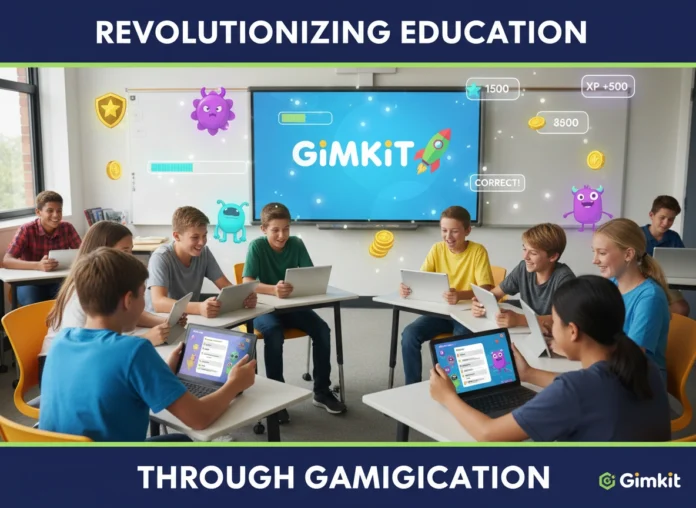
Education has undergone a dramatic transformation over the last decade. The image of a quiet classroom with rows of students staring at a chalkboard is rapidly fading. In its place, we see vibrant, interactive environments where technology bridges the gap between traditional instruction and modern engagement. At the forefront of this shift is gamification—the application of game-design elements in non-game contexts. While many platforms have entered this arena, few have captured the imagination of students and teachers quite like Gimkit.
Created by a high school student who felt frustrated by rote memorization, Gimkit is not just another quiz app. It is a dynamic ecosystem that combines assessment with strategy, economics, and high-stakes gameplay. This article explores how Gimkit is redefining the educational landscape, turning passive learning into an active, strategic pursuit.
The Gamification of the Classroom
To understand Gimkit’s impact, we must first look at the soil from which it grew: gamification. For years, educators struggled with a fundamental disconnect. Students could spend hours mastering complex video game mechanics, memorizing stats, and collaborating on raids, yet struggled to retain basic historical dates or vocabulary words. The problem wasn’t capacity; it was engagement.
Gamification leverages the psychological triggers that make games addictive—competition, immediate feedback, progress tracking, and rewards—and applies them to learning objectives. It transforms the “chore” of studying into a quest for mastery. However, early attempts at gamification often felt superficial. Badges and leaderboards were slapped onto traditional quizzes without changing the core experience. This is where Gimkit diverged from the pack. It didn’t just add points to a quiz; it turned the quiz into a resource-management game.
What is Gimkit?
Gimkit is a live learning game show platform used in classrooms globally. Unlike its predecessors, such as Kahoot! or Quizizz, which focus primarily on speed and accuracy in a linear fashion, Gimkit introduces an economic layer to the assessment.
In a standard Gimkit game, students answer questions on their own devices at their own pace. Correct answers earn them in-game currency. This currency is where the magic happens. Students can use their earnings to purchase upgrades and power-ups. Some upgrades increase the money earned per question (a multiplier), while others provide insurance against wrong answers. Power-ups can be used to freeze opponents, subtract points from the leader, or boost the entire team’s earnings.
This structure means that knowledge is the fuel, but strategy is the engine. A student doesn’t need to be the fastest reader or the quickest clicker to win; they need to make smart investment decisions with the currency they earn from their knowledge.
Unique Features that Drive Engagement
Gimkit’s success lies in its unique feature set, which caters to diverse learning styles and keeps the gameplay fresh.
1. The Economy of Learning
The most distinct feature is the shop. By allowing students to buy upgrades, Gimkit introduces concepts of investment and delayed gratification. A student might ask, “Should I spend my $50 now to get a small boost, or save up $200 for a massive multiplier?” This adds a layer of metacognition to the review process. Students are constantly evaluating their performance and strategy in real-time.
2. Diverse Game Modes
Gimkit keeps the experience novel by offering rotating game modes.
- Trust No One: Inspired by the viral success of Among Us, this mode tasks students with identifying impostors within the class while answering questions to keep the ship running. It fosters deduction and social interaction alongside content review.
- The Floor is Lava: A cooperative mode where the class must work together to build a structure high enough to stay above the rising lava. It shifts the dynamic from competition to collaboration.
- Fishtopia: A more relaxed, open-world style mode where students fish and sell their catch, using question-answering as the mechanism to buy bait and gear.
3. KitCollab
This feature flips the script on content creation. Instead of the teacher generating all the questions, KitCollab allows students to submit their own questions to the game. The teacher accepts or rejects them in real-time. This turns the review session into a collaborative effort where students take ownership of the material, assessing their own understanding as they craft questions for their peers.
Benefits for Educators and Students
The platform offers distinct advantages that address common pain points in education.
For Students:
- Reduced Anxiety: Because students answer at their own pace rather than waiting for a timer on a big screen, the pressure is lower. If they get a question wrong, they don’t lose their turn; they just lose a bit of currency (or nothing, if they bought insurance). They can immediately try again.
- Level Playing Field: The power-up system allows students who might struggle academically to stay competitive through smart strategy or by using saboteur items to slow down the leaders. It keeps the game exciting for everyone, not just the top achievers.
- Repetition without Boredom: To earn enough money for big upgrades, students must answer questions repeatedly. Gimkit cycles through the question bank, ensuring students see the material multiple times. The game mechanics disguise the rote repetition required for memory consolidation.
For Educators:
- Data-Driven Insights: After every game, Gimkit provides a detailed report. Teachers can see which questions were missed most frequently and which students are struggling. This allows for immediate intervention and targeted re-teaching.
- Ease of Use: Gimkit integrates with existing tools like Quizlet. Teachers can import sets they’ve already created, meaning a new game can be set up in seconds.
- Homework Assignments: Gimkit isn’t just for live class. Teachers can assign “Assignments” where students play asynchronously to reach a monetary goal. It turns homework into a challenge rather than a worksheet.
Classroom Impact: Beyond the Scoreboard
The true revolution happens in the classroom atmosphere. When a teacher launches a Gimkit session, the energy shifts. Passive listeners become active participants.
Consider a high school Spanish class reviewing vocabulary. In a traditional setting, this might involve flashcards or a silent worksheet. With Gimkit, the room is buzzing. Students are shouting (mostly) encouraging things to teammates during a cooperative mode like “Infinity Mode,” strategizing on who should buy the “Streak Bonus” and who should save up for the “Team Multiplier.”
The impact on learning outcomes is tangible. Teachers report that students ask to play Gimkit. When students want to review, they spend more time with the material. The “grind” mechanics of the game incentivize answering more questions than a standard worksheet ever could. A student might answer 60 questions in a 10-minute Gimkit session just to earn enough virtual money for a specific upgrade. That volume of practice drives retention.
Furthermore, the game promotes soft skills. Financial literacy concepts are baked into the upgrade system. Cooperative modes teach teamwork and communication. The “impostor” modes teach critical thinking and debate. It becomes a holistic learning experience.
Challenges and Limitations
Despite its success, Gimkit is not a silver bullet. Like any technology, it has limitations that educators must navigate.
- The Distraction Factor: The game mechanics are so engaging that they can sometimes overshadow the content. Students might focus so intently on the economy and buying power-ups that they blindly guess on questions just to get money faster. Teachers have to monitor accuracy rates to ensure genuine learning is happening.
- Screen Fatigue: In an era where students are glued to devices, adding another screen-based activity needs to be done in moderation. Overuse can lead to burnout or diminished returns on engagement.
- Equity and Access: While Gimkit can be played on smartphones, tablets, or laptops, it relies on every student having a device and a stable internet connection. In underfunded districts or rural areas with poor connectivity, this creates a barrier to entry.
- Cost: While there is a free version, the most robust features and unlimited access require a paid subscription (Gimkit Pro). For teachers paying out of pocket, this is an added burden.
The Future of Gamification in Education
Gimkit represents “Gamification 2.0.” It has moved past simple points and badges into complex, immersive systems that mimic the video games students play at home. As we look to the future, the role of platforms like Gimkit will likely expand.
We can expect to see deeper integration of AI, where the game adjusts the difficulty of questions in real-time based on the student’s performance, creating a perfectly personalized learning curve. We might see persistent worlds where a student’s progress in math contributes to the growth of a virtual civilization over the course of a semester.
Gimkit has proven that learning doesn’t have to be dry to be effective. By respecting students’ desire for agency, strategy, and fun, it has revolutionized the review process. It reminds us that at its core, learning is a natural, playful instinct. When education aligns with that instinct, the walls of the classroom expand, and the ceiling for student potential disappears. As technology evolves, the question isn’t whether games belong in the classroom, but how far we can take them to inspire the next generation of learners.
Please visit website for more info.