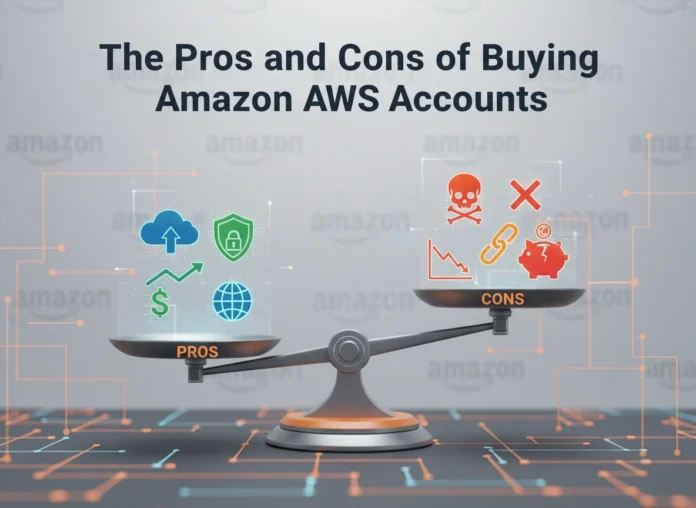
The Pros and Cons of Buying Amazon AWS Accounts

Buy Amazon Aws Accounts Web Services (AWS) stands as a titan in the cloud computing industry. It offers a vast and ever-expanding suite of services, from simple data storage and computing power to complex machine learning and artificial intelligence tools. For businesses of all sizes, AWS provides the infrastructure to build, deploy, and scale applications with remarkable flexibility. The standard path to accessing these services is straightforward: create a new account directly with Amazon. However, a secondary market has emerged where individuals and businesses can buy pre-existing AWS accounts.

This practice raises important questions about its benefits and drawbacks. While the idea of acquiring a ready-made account might seem appealing, it’s a path filled with significant risks and complexities. This article will explore the reasons why someone might consider buying an AWS account, weigh the potential pros against the substantial cons, and discuss safer alternatives. We will cover the potential for time savings and access to specific configurations, but also delve into the serious security vulnerabilities, compliance nightmares, and direct violations of Amazon’s terms of service.

Why Consider Buying an AWS Account?

The allure of purchasing an AWS account often stems from a desire to bypass the standard setup process or gain perceived advantages. While creating a new account is free, certain scenarios lead people to explore this gray market.

Perceived Cost Savings and Spending Limits

One of the most common motivations is the belief that a purchased account might come with a higher initial spending limit or access to credits. New accounts sometimes have lower default service quotas, which can be a hurdle for projects that require significant resources from day one. A seller might advertise an “aged” account with a proven history of high usage, suggesting it has higher, pre-approved limits. This can be attractive to developers who want to avoid the process of requesting limit increases from AWS support.

Pre-Configured Environments

Another reason is the appeal of a turnkey solution. Some sellers offer accounts that are pre-configured for specific tasks, such as running large-scale data processing jobs, hosting complex web applications, or even for activities that might be flagged on a new account. For a team without the requisite expertise, buying an account that already has the necessary Virtual Private Clouds (VPCs), security groups, and IAM (Identity and Access Management) roles configured can seem like a shortcut to getting a project off the ground.

Access to Region-Specific or Beta Features

In some cases, access to certain AWS services or features is rolled out regionally or is available only in a limited beta. An account that already has access to these exclusive features can be a valuable commodity. A developer in a region without access might be tempted to purchase an account based in a different region to experiment with new technology before it’s widely available.

The Potential Benefits of a Purchased Account

While fraught with risk, the perceived advantages of buying an AWS account are what drive the market. It’s important to understand these supposed benefits to see why this option can seem tempting.

Time Efficiency

Setting up a new AWS account, especially for a complex enterprise environment, is not instantaneous. It involves configuring billing alerts, setting up security protocols with IAM users and roles, establishing organizational units, and requesting service quota increases. Purchasing an account that has some of this foundational work completed can theoretically save hours or even days of administrative effort, allowing a team to focus directly on development and deployment.

Scalability and Established History

An established AWS account with a history of consistent, legitimate usage may have an easier time scaling resources. AWS systems may be less likely to flag sudden spikes in resource consumption as suspicious on an account with a proven track record. This can be particularly appealing for businesses planning rapid growth or expecting unpredictable traffic, as it may reduce the friction involved in scaling up services on demand.

Access to Specialized Tools

Some purchased accounts may come with access to the AWS Marketplace, with subscriptions to third-party software already in place. This could include security tools, databases, or developer software. The buyer might see this as a way to acquire a bundle of services without having to individually procure and configure each one.

The Significant Risks and Downsides

The potential benefits of buying an AWS account are heavily outweighed by a long list of severe risks. Engaging in this practice can lead to financial loss, data breaches, and legal trouble, making it a dangerous gamble for any serious business or developer.

Security and a Compromised Foundation

This is the most critical risk. When you buy an AWS account, you have no way of knowing its true history or who else might have access. The seller could retain hidden administrative access through undisclosed IAM users or access keys. These “backdoors” would allow them to access your data, modify your infrastructure, or run their own resource-intensive tasks on your dime. You are essentially building your digital house on a foundation you did not lay and cannot trust. A malicious seller could wait until you have deployed sensitive customer data or valuable intellectual property before exploiting their access.

Violation of AWS Terms of Service

The AWS Customer Agreement, the contract every user agrees to, explicitly prohibits the sale or transfer of accounts. Section 11.4 states, “You will not misrepresent or embellish the relationship between us and you… You will not assign or otherwise transfer this Agreement or any of your rights and obligations under this Agreement, without our prior written consent.” Buying an account is a direct violation of this agreement. If AWS discovers the transfer, they have the right to suspend or terminate the account immediately and without warning. This could result of the instant and permanent loss of all data and infrastructure hosted within it.

Compliance and Regulatory Nightmares

For any business that handles sensitive information—such as personal data, financial records, or health information—using a purchased AWS account is a compliance disaster. Regulations like GDPR, HIPAA, and PCI DSS require strict controls over data access and a clear chain of custody. It is impossible to prove compliance when you cannot account for the entire history of the environment. You cannot guarantee that the account hasn’t been previously compromised or that it meets the necessary security standards. A data breach under these circumstances could lead to massive fines, lawsuits, and irreparable damage to your company’s reputation.

Hidden Costs and Billing Issues

The billing history of a purchased account can be a minefield. The account could have outstanding balances or be linked to a stolen credit card. When AWS identifies the fraudulent payment method, they will hold the current user responsible for the costs. Furthermore, a seller could rack up huge bills through a hidden backdoor and then disappear, leaving you to deal with the financial fallout. Untangling these billing disputes with AWS support can be a nightmare, especially when you have to admit you acquired the account in a way that violates their terms.

Safer and Ethical Alternatives

Given the overwhelming risks, buying an AWS account is never a recommended practice. Fortunately, there are legitimate and secure ways to achieve the same goals.

Use AWS Organizations and IAM

If the goal is to provide pre-configured environments for different teams or projects, AWS Organizations is the proper tool for the job. You can create a master account and then provision new, separate member accounts under it. Using Service Control Policies (SCPs), you can enforce security and spending guardrails centrally. With IAM roles and cross-account access, you can securely grant permissions without sharing credentials. This provides separation and control without violating any terms.

Leverage Infrastructure as Code (IaC)

To achieve time efficiency and create repeatable, pre-configured setups, use Infrastructure as Code (IaC) tools like AWS CloudFormation or Terraform. With IaC, you define your entire cloud environment—VPCs, subnets, security groups, servers, and more—in code templates. This allows you to deploy a complete, standardized architecture in a new AWS account in minutes. The templates can be version-controlled, shared, and audited, providing a far more secure and efficient method than buying a pre-configured account.

Plan Ahead for Service Quota Increases

If you anticipate needing high resource limits, the correct approach is to plan ahead. As you set up your new AWS account, work with AWS support to proactively request increases for the service quotas you expect to need. By providing a clear business case and forecasting your usage, you can get the limits you require. This process is part of building a healthy relationship with AWS and demonstrates that you are a legitimate user.

A Balanced Perspective

The market for buying AWS accounts exists because it promises shortcuts. The ideas of saving time, bypassing limits, and acquiring a ready-made environment are tempting. However, these perceived benefits are an illusion that masks a reality of extreme risk. The potential for security breaches, the certainty of violating AWS terms of service, and the high likelihood of compliance and billing problems make this practice untenable for any reputable operation.

There are no shortcuts to building a secure, scalable, and compliant cloud infrastructure. The proper path involves using the powerful tools AWS provides, such as AWS Organizations for governance and IaC for automation. By investing the time to set up an account correctly and engaging with AWS support to plan for your needs, you build on a solid foundation that you control completely. The small amount of time you might save by purchasing an account is not worth the catastrophic risk of losing your data, your money, and your business’s reputation.


Explore more

How Techleez Empowers Global Tech Enthusiasts

How Techleez Empowers Global Tech Enthusiasts

Techleez is a digital educational platform that empowers tech enthusiasts worldwide by providing practical tech tips, unbiased app reviews, and guides on artificial intelligence...
How will Techlein shape the future of cloud computing?

How will Techlein shape the future of cloud computing?

Techlein’s vision for cloud computing integrates advanced artificial intelligence, hybrid cloud architectures, and sustainable infrastructure to drive business innovation in 2026 and beyond. By...
Gamevault: The perfect solution for organizing your PC games Quick answer: The GameVault self-hosted gaming platform is a dedicated application for organizing and distributing legally owned, DRM-free PC games. By deploying GameVault on a personal server, gamers can bypass third-party storefronts, track playtime statistics, enrich game metadata automatically, and maintain total ownership over their digital game libraries. Managing a massive PC game collection across multiple digital storefronts often frustrates PC gamers. Users purchase titles from various providers, resulting in fragmented libraries scattered across half a dozen proprietary clients. This fragmentation forces players to run unnecessary background software, consuming valuable system resources just to launch a single title. Digital ownership also presents a growing concern for modern software consumers. When you purchase a title on a major storefront, you typically purchase a license to access the software rather than the software itself. If a platform revokes your license, shuts down its servers, or removes a specific title due to licensing disputes, you lose access to your purchase entirely. This reality has driven a massive resurgence in the popularity of DRM-free (Digital Rights Management-free) software, where consumers can download standalone installation files and retain them indefinitely. However, accumulating hundreds of DRM-free installation files creates a new organizational challenge. Storing loose executable files and zipped archives on external hard drives makes finding, installing, and updating titles incredibly tedious. PC gamers need a centralized, organized way to view their offline collections. The GameVault self-hosted gaming platform solves this exact problem. By bringing the polished interface of a commercial storefront to your private home server, GameVault allows you to catalog, distribute, and play your legally owned DRM-free collection with exceptional ease. This article explores how GameVault works, details its core features, and explains why it serves as the ultimate game organization tool for dedicated PC gamers. What is the GameVault self-hosted gaming platform? The GameVault self-hosted gaming platform is a specialized ecosystem designed to host, manage, and distribute DRM-free game files from a private server. Unlike aggregator tools that simply combine existing store libraries into one visual interface, GameVault operates entirely independently of corporate storefronts. You supply the game files, host the server, and control the entire ecosystem. GameVault consists of two main components: the backend server and the frontend client. The backend server runs on your personal hardware (such as a NAS device, a Virtual Private Server, or a dedicated home server) and indexes your raw game files. It scans your designated storage directories, identifies the game archives, and builds a comprehensive database. The frontend client operates as a native Windows application or a responsive Web UI. This client connects to your private server, presenting your raw files as a visually stunning, highly organized game library. Users can browse their collections, click a single button to download the files to their local machine, and launch the title directly from the GameVault interface. Because the games run locally on your hardware, you never have to worry about the latency or video compression issues associated with cloud game streaming. Which core features does GameVault use to organize your game library? Organizing a massive catalog of software requires robust features. The GameVault self-hosted gaming platform provides an extensive suite of tools designed to automate library management and enhance the user experience. Automatic metadata enrichment through IGDB Manually adding cover art, descriptions, release dates, and developer information for hundreds of titles wastes countless hours. GameVault automates this entire process through a direct integration with IGDB (Internet Game Database). When you drop a new game folder into your server directory, GameVault scans the file name and automatically queries the IGDB API. The server fetches high-quality cover art, background images, genre tags, and detailed game summaries. By default, GameVault caches this metadata for 30 days to ensure your library always displays the most accurate and up-to-date information. Users simply add their files to a folder, and GameVault handles the visual presentation. Detailed playtime and progress tracking Tracking the time spent inside a virtual world remains a highly requested feature for PC gamers. GameVault monitors your active sessions and records your exact playtime for every title in your library. The application logs when you start an application and when you close it, compiling detailed statistics over time. This feature allows users to easily manage their backlog of unplayed titles. You can sort your library by playtime to identify neglected purchases or view your most played titles of the year. The platform also supports save file management. Users can configure GameVault to upload up to 10 localized save files per game directly to the server, ensuring your progress remains backed up and accessible. Multi-user social features and account management GameVault transforms a solitary hard drive into a private gaming community. Server administrators can create individual user accounts for friends and family members. Each user receives their own personalized view of the library, independent playtime tracking, and customized client settings. Administrators maintain complete control over user permissions. You can restrict access based on parental controls, establishing an age of majority (such as 18) and filtering out mature titles for younger users. The platform also features online activity statuses, allowing you to see exactly what your friends are currently playing in real-time. What are the main benefits of using GameVault for gamers? Choosing to self-host your library requires a small initial time investment, but the long-term benefits for digital software consumers are substantial. Total digital ownership and preservation The primary benefit of using GameVault is absolute digital preservation. Because GameVault focuses exclusively on DRM-free software, you never have to authenticate your purchases through a third-party server. If your internet connection drops, your GameVault client still launches your installed titles flawlessly. You preserve the history of your digital media exactly as you purchased it, entirely insulated from corporate licensing changes or server shutdowns. Escaping aggressive platform DRM Modern storefronts often package titles with aggressive DRM software that requires an always-online connection. This DRM can degrade application performance, increase loading times, and introduce software conflicts. By curating a DRM-free library inside GameVault, you ensure your PC runs only the code necessary to play the title itself. Enhanced privacy and data security Commercial launchers harvest extensive amounts of user data, tracking your browsing habits, hardware configurations, and purchasing history to serve targeted advertisements. The GameVault self-hosted gaming platform respects user privacy by design. All telemetry, playtime data, and library statistics remain localized on your personal database. The software does not track your data for marketing purposes, ensuring your recreational habits remain entirely private. How does GameVault streamline your daily gaming experience? GameVault makes interacting with offline files incredibly efficient. Setting up the platform requires a basic understanding of server deployment, but the daily usage experience mirrors the convenience of enterprise software. Seamless Docker Compose deployment Administrators can deploy the GameVault backend in minutes using Docker and Docker Compose. Docker isolates the application inside a container, preventing software conflicts with other services running on your hardware. To streamline the installation, GameVault utilizes a simple docker-compose.yml file. Administrators map their local game folders to the container's internal /files directory, set up a PostgreSQL database connection, and start the service with a single command. The software also supports advanced configuration hierarchies, allowing users to define settings via Docker Secrets, environment variables, or organized YAML files. Automated file extraction and installation When a user clicks "Download" on the GameVault client, the software initiates a direct file transfer from the private server to the local machine. The platform supports massive bandwidth limits, allowing users on local networks to download massive applications in minutes. GameVault automatically handles complex archive formats like .zip, .7z, and .rar. It extracts the contents to the user's local directory and intelligently identifies the primary executable file required to launch the application. For standard Windows setup files, GameVault can even utilize default command-line parameters (such as /SILENT) to attempt a completely automated background installation. How to choose between GameVault and other game launchers? When evaluating game organization tools, consumers often compare GameVault to other popular clients like Playnite or GOG Galaxy. The correct choice depends entirely on how you purchase and store your software. Choose the GameVault self-hosted gaming platform if your primary goal is hosting and distributing your own raw, DRM-free installation files from a centralized server to multiple client machines. GameVault excels when you want to act as your own private storefront, completely independent of external account integrations. Choose Playnite or GOG Galaxy if you rely heavily on DRM-protected purchases from major storefronts (like Steam or Epic Games) and simply want a unified visual interface to launch them. These aggregator tools scan your local machine for installed storefront clients and launch the corresponding DRM software required to play the title. They do not host your installation files or distribute them across a network. Ready to take back control of your game collection? The shift toward self-hosted software solutions represents a necessary evolution in digital media preservation. As digital storefronts become more restrictive, gamers need reliable tools to manage the media they legally own. The GameVault self-hosted gaming platform offers a polished, robust, and highly customizable environment that respects both the user and the software. By combining automated metadata enrichment, detailed playtime tracking, and effortless file distribution, it provides a premium library experience without the drawbacks of corporate oversight. Start organizing your DRM-free collection today by exploring the GameVault documentation and deploying your first container. Frequently asked questions about GameVault Can GameVault manage my Steam or Epic Games library? No. GameVault is built specifically for organizing and distributing DRM-free content, such as titles purchased from GOG or Humble Bundle. It cannot bypass the proprietary DRM used by major storefronts. Is the GameVault self-hosted gaming platform free to use? Yes, the core ecosystem of the GameVault self-hosted gaming platform is entirely free to download and deploy. The developers offer an optional GameVault+ premium subscription for users seeking advanced features, but the foundational library management tools remain permanently free. Do I need a PostgreSQL database to run GameVault? While the developers strongly recommend using a PostgreSQL database for optimal performance and stability, GameVault does support SQLite for users who prefer a simpler, single-file database structure during testing or lightweight deployments. Can I run the GameVault client on Linux or macOS? Currently, GameVault provides a native desktop client specifically for Windows operating systems. However, users on Linux and macOS can fully access their organized libraries, download files, and manage their profiles using the platform's responsive Web UI. Does GameVault support cloud game streaming? No. GameVault operates strictly as a library management and file distribution platform. Users download the game files from the server to their local machine, and the application utilizes the local hardware's processing power to run the software. Meta data Meta title GameVault: The Perfect Solution for Organizing Your Games Meta description Discover how the GameVault self-hosted gaming platform helps you organize, manage, and distribute your DRM-free PC game collection with automated metadata.

Gamevault: The perfect solution for organizing your PC games

The GameVault self-hosted gaming platform is a dedicated application for organizing and distributing legally owned, DRM-free PC games. By deploying GameVault on a personal...

Why 1xbet Mobile is Bangladesh’s Betting Future

The landscape of sports betting and online gaming across South Asia is shifting rapidly. Gone are the days when placing a wager required a...
The Ultimate Guide to Buying Sports Guest Posts

The Ultimate Guide to Buying Sports Guest Posts

Building a successful sports website requires more than just publishing great articles or selling top-tier merchandise. You need search engines to recognize your site...
Top Mistakes to Avoid When Buying Finance Guest Posts

Top Mistakes to Avoid When Buying Finance Guest Posts

Securing high-quality backlinks in the financial sector requires a careful, strategic approach. Search engines apply strict scrutiny to websites dealing with money, investing, and...
The Risks and Rewards of Buying PBN Backlinks

The Risks and Rewards of Buying PBN Backlinks

Building a powerful link profile is one of the most challenging aspects of search engine optimization. You can write exceptional content and optimize your...
Outrank Your Rivals: The Ultimate Guide to Editorial Links

Outrank Your Rivals: The Ultimate Guide to Editorial Links

Securing a top spot on search engine results pages is one of the most challenging aspects of digital marketing. Countless businesses vie for the...