Data breaches have become an almost daily headline, costing organizations billions and eroding consumer trust. Traditional data security models, often centralized and siloed, are struggling to keep pace with the sophistication of cyber threats. In this landscape, blockchain technology emerges as a powerful force for change, offering a fundamentally new approach to securing digital information. Its decentralized and immutable nature provides a robust framework to combat the vulnerabilities plaguing conventional systems.
This article explores how blockchain is revolutionizing data security. We will break down its core principles, examine the current security challenges it solves, and look at real-world applications that are already making an impact. By understanding this technology, we can see the future of a more secure digital world.
Understanding Blockchain Technology
At its core, blockchain is a distributed, immutable ledger. Think of it as a digital record book that is shared among many computers in a network. Once a transaction or piece of data is added to this book, it cannot be altered or deleted. This creates a permanent and transparent record of information.
Core Principles of Blockchain
Three key principles give blockchain its power to secure data:
- Decentralization: Unlike traditional databases that store information in a central location (a single server or a cluster of servers), a blockchain distributes identical copies of the ledger across its entire network. There is no single point of failure or control, which makes it incredibly resilient to attacks and technical failures. If one computer (or node) goes offline, the network continues to operate without interruption.
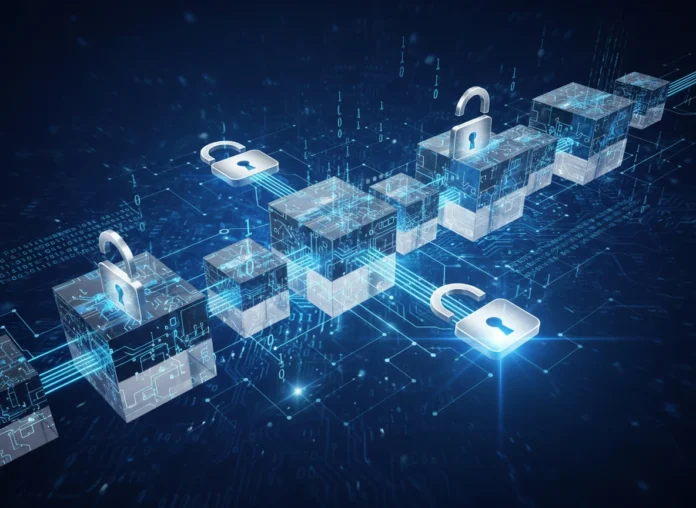
- Immutability: Data is recorded on the blockchain in blocks, which are linked together chronologically to form a chain. Each block contains a cryptographic hash of the previous block, creating a secure and unbreakable link. Any attempt to alter the data in a previous block would change its hash, which would break the chain and be immediately rejected by the network. This makes the data tamper-proof.
- Transparency and Cryptography: While “transparency” might seem counterintuitive for security, on a blockchain it means that all transactions are visible to participants in the network. However, the identities of the participants are protected through advanced cryptography. Data is secured using public and private key pairs, ensuring that only the authorized owner can access or transfer their assets or information. This creates a system that is both auditable and private.
The Current Challenges in Data Security
Conventional security systems are facing a growing number of challenges. They are often built around a centralized model, which creates significant vulnerabilities that attackers are keen to exploit.
Centralized Points of Failure
The most significant weakness of traditional systems is their reliance on a central server or database. This “honeypot” of data becomes a prime target for cybercriminals. A single successful breach can compromise millions of records, as seen in numerous high-profile incidents involving large corporations and government agencies. This centralized architecture is a single point of failure; if the central server is compromised, the entire system is at risk.
Data Integrity and Trust Issues
How can you be certain that the data you are viewing has not been tampered with? In centralized systems, a malicious insider or an external attacker who gains administrative access could alter or delete records without leaving a clear trace. This makes it difficult to guarantee data integrity, which is crucial for financial records, healthcare data, and supply chain management. Establishing trust in the data requires costly and time-consuming audits.
Lack of User Control
In the current digital ecosystem, users often have little to no control over their personal data. Companies collect, store, and monetize user information, often with limited transparency. Users must trust these organizations to protect their data, but repeated breaches have shown that this trust is often misplaced. Individuals lack the ability to manage who accesses their data and for what purpose.
How Blockchain Addresses These Security Challenges
Blockchain’s unique architecture directly counters the weaknesses of traditional security models. It offers a new paradigm for data protection built on distribution, integrity, and user empowerment.
Eliminating Single Points of Failure
By its very nature, a decentralized blockchain has no single point of failure. Data is replicated across hundreds or thousands of nodes, making it virtually impossible for an attacker to take down the entire network or alter records simultaneously. To compromise the ledger, an attacker would need to control more than 51% of the network’s computing power—a feat that is prohibitively expensive and complex for any significant blockchain network.
Ensuring Data Integrity Through Immutability
Blockchain’s cryptographic linking of blocks ensures that data is immutable. Once a record is added to the ledger and verified by the network, it cannot be changed. This is particularly valuable for applications where audibility and proof of existence are critical. For instance, in supply chain management, a product’s journey can be recorded at every step. This creates a permanent, tamper-proof record that prevents fraud and confirms authenticity. Any attempt to alter a record would be immediately visible to all participants.
Enhancing Privacy and Control with Cryptography
Blockchain technology empowers individuals by giving them control over their own data. Through a concept known as Self-Sovereign Identity (SSI), users can manage their own digital identities without relying on a central authority. Personal information is stored securely on a device controlled by the user, and they can grant temporary, verifiable access to third parties using cryptographic signatures. This means you can prove your age without revealing your date of birth or prove your address without sharing other personal details.
Real-World Applications of Blockchain in Data Security
The theoretical benefits of blockchain are already being put into practice across various industries to solve real-world security problems.
- Securing Healthcare Data: Patient data is extremely sensitive, and the healthcare industry is a frequent target for cyberattacks. Blockchain can be used to create a secure and interoperable system for managing electronic health records (EHRs). Patients can grant doctors, hospitals, and insurers permissioned access to their records, with every access logged on an immutable ledger. This enhances patient privacy while improving data sharing for better care.
- Protecting Financial Transactions: The financial services industry was the first to widely explore blockchain. The technology provides a secure way to conduct and record transactions without needing a traditional intermediary like a bank. This reduces the risk of fraud, minimizes transaction fees, and speeds up settlement times. Decentralized Finance (DeFi) platforms leverage blockchain to offer lending, borrowing, and trading services in a more transparent and secure manner.
- Securing the Internet of Things (IoT): The number of connected IoT devices is exploding, but many of these devices have weak security, making them vulnerable to being hijacked for large-scale botnet attacks. Blockchain can create a secure framework for IoT. Devices can be registered on a blockchain, and all communications between them can be authenticated and recorded on the ledger. This prevents unauthorized devices from joining the network and ensures that data transmitted between devices is not tampered with.
The Future Potential of Blockchain for Data Security
The role of blockchain in data security is still evolving, but its potential is vast. As the technology matures, we can expect to see several key trends emerge.
One major area of development is the integration of blockchain with other advanced technologies like Artificial Intelligence (AI) and machine learning. AI algorithms could be used to monitor blockchain networks for suspicious activity in real-time, identifying and flagging potential threats before they can cause harm.
Furthermore, as scalability solutions like Layer 2 protocols and sharding become more widespread, blockchain will be able to handle a higher volume of transactions more efficiently. This will make it a more viable option for large-scale enterprise applications, from securing global supply chains to managing national identity systems.
The move towards a decentralized web, or Web3, is also heavily reliant on blockchain. In this new iteration of the internet, users will own and control their data, interact with decentralized applications (dApps), and transact in a peer-to-peer fashion. Blockchain provides the foundational security and trust layer needed to make this vision a reality.
In conclusion, blockchain technology offers a fundamental shift in how we approach data security. By moving away from vulnerable centralized models and embracing decentralization, immutability, and cryptographic control, we can build more resilient, transparent, and user-centric systems. While challenges remain, the ongoing innovation in this space signals a future where our digital lives are significantly safer and more secure.
Please click here for more info